Kairos Power Completes Graphite Qualification Testing for Advanced Reactors

Highlights:
- Kairos Power completed a multi-year graphite qualification program to characterize manufactured ET-10 nuclear-grade graphite materials for use in advanced reactors.
- Nearly 3,000 graphite specimens were machined and tested in partnership with Ibiden Co. LTD to measure performance.
- The effort is believed to be the first graphite grade qualified under the ASME Section III, Division 5 HHA-III-4100 design code for high-temperature reactor components.
- Data will inform the development, licensing, and deployment of the Hermes reactor series and future fluoride salt-cooled high-temperature reactors.
Kairos Power has completed qualification testing that validates the performance of manufactured ET-10 graphite for use in its advanced reactors.
The three-year testing campaign establishes key performance data that will support the design and licensing of the Hermes reactor series and our future commercial fleet.
Graphite Qualification Testing
Graphite is a crucial material used in Kairos Power’s fluoride salt-cooled high-temperature reactor (KP-FHR).
It forms several structural components that reflect neutrons, guide coolant flow, and ensure key safety systems operate reliably.
Because nuclear-grade graphite is manufactured differently by each supplier, reactor developers must carefully test and qualify the specific graphite grades they plan to use.
To support this effort, Kairos Power conducted an extensive materials testing program using ET-10 graphite in collaboration with strategic partner, Ibiden.
Engineers machined nearly 3,000 graphite specimens to extremely tight tolerances—many within hundredths of a millimeter—and tested them to destruction to assess their performance.
The program evaluated a wide range of physical and mechanical properties, including density, thermal conductivity and expansion, and tensile strength, to ensure the graphite that will go into Hermes performs as expected.

“These results statistically validate the material that’s needed to support our reactor design and future licensing activities,” said James McGladdery, lead engineer for graphite materials at Kairos Power. “Completion of this qualification testing ensures we have a strong technical foundation for the graphite components used in our reactor cores.”
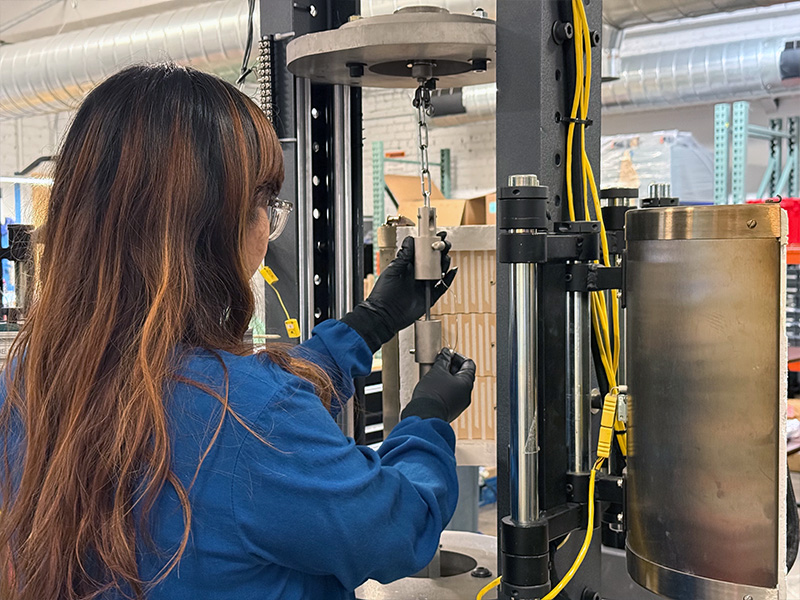
As part of the testing campaign, Kairos Power engineers leaned on the company’s internal manufacturing, materials science, and mechanical testing capabilities to develop and execute in-house tensile strength testing.
The majority of the ET-10 graphite specimens were manufactured by Ibiden and the rest were machined at Kairos Power’s Manufacturing Development Campus in Albuquerque, New Mexico, to meet rigorous nuclear testing standards.
Specialized grips were also developed in-house after progressing through several rapid iterative design cycles to effectively conduct tensile strength testing experiments at Kairos Power’s headquarters in Alameda, California.
.jpg)
.jpg)
.jpg)
.jpg)
The resulting data will support materials documentation for the Hermes reactor’s upcoming operating license application and inform future reactor designs.
“Our graphite qualification program demonstrates the depth of engineering expertise and vertical integration we’ve built at Kairos Power,” said Micah Hackett, vice president for fuels and materials at Kairos Power. “By combining strong supplier partnerships with in-house testing capabilities, we’re able to control cost and accelerate materials qualification for our advanced reactors.”
Coming Up
Kairos Power will continue conducting complementary testing programs to study graphite performance under reactor conditions.
The company has several agreements in place with NRG Pallas to perform irradiation experiments to help engineers understand how graphite and steel components will perform over the lifetime of a reactor core.
NRG Pallas announced the start of a second round of ET-10 irradiation creep tests that will help Kairos Power better predict the performance of structural graphite used in its reactors.
The first phase of irradiation-creep testing was completed in November 2025, which were the first experiments of their kind for ET-10 graphite.
ET-10 graphite is being used in all three of Kairos Power’s Engineering Test Units — a series of non-nuclear hardware demonstrations that will inform the design, build, and operation of the Hermes Low-Power Demonstration Reactor (Hermes 1).
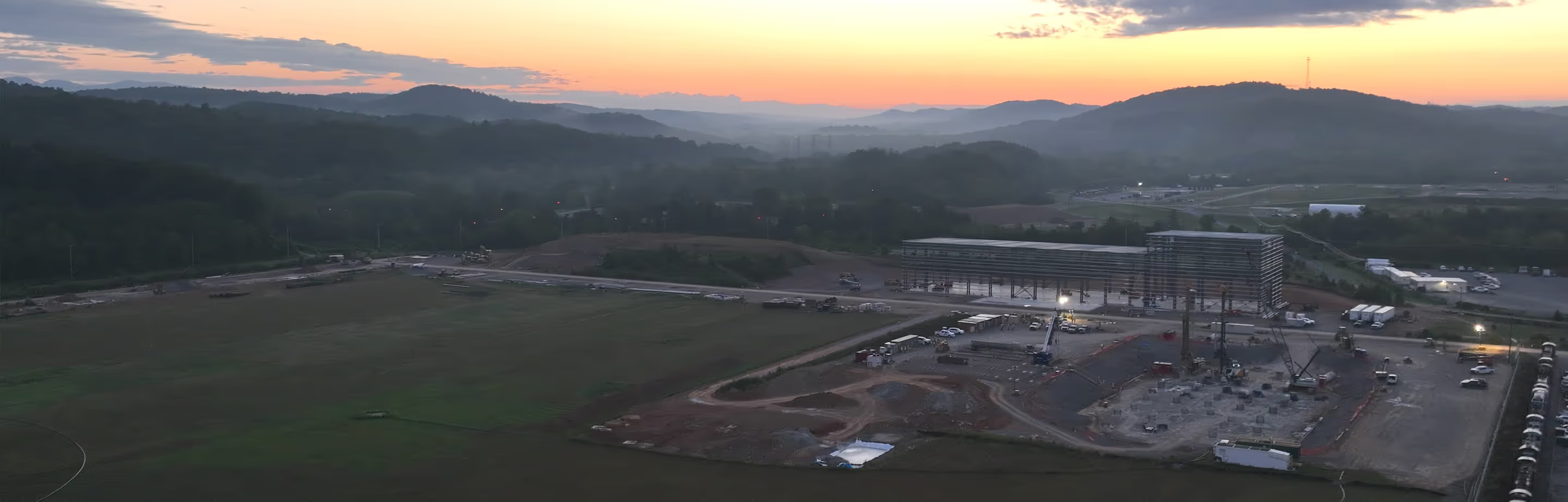
Hermes 1 is currently under construction in Oak Ridge, Tennessee.
It will be the first nuclear-fueled reactor to demonstrate heat production for Kairos Power’s fluoride salt–cooled high-temperature reactor technology.