Kairos Power Completes Key Fuel Performance Milestone for Future Reactor Licensing
.jpg)

Highlights:
- Kairos Power completed verification and validation of its KP-BISON fuel performance code.
- KP-BISON models the behavior and integrity of TRISO fuel particles operating in a high-temperature, salt-cooled reactor system.
- Kairos Power will leverage the final reports to support its fuel safety case with the U.S. Nuclear Regulatory Commission for licensing future nuclear reactors.
Kairos Power has completed verification and validation (V&V) reports for the KP-BISON fuel performance code. The modeling tool analyzes how TRISO particles behave within Kairos Power’s fluoride salt-cooled high-temperature reactor (KP-FHR).
The company plans to submit the reports to the U.S. Nuclear Regulatory Commission (NRC) to support licensing future reactors. If approved, KP-BISON would be the first application for modeling TRISO fuel performance in molten salt reactors.
Robust Fuel Design
The KP-FHR operates on graphite fuel pebbles that contain thousands of poppyseed-sized TRISO particles. Each particle consists of a uranium oxycarbide (UCO) fuel kernel coated with multiple protective layers of ceramic and carbon materials to prevent the release of fission products.
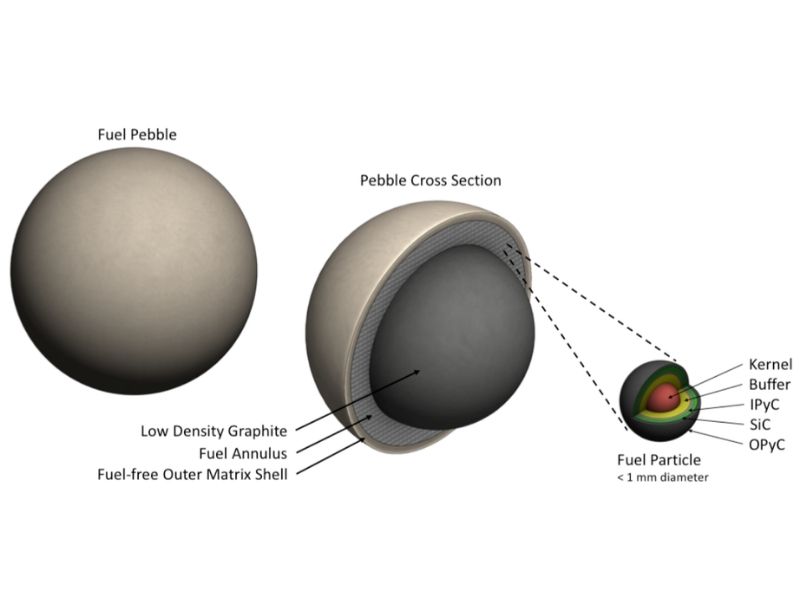
Kairos Power's safety case is based on the combination of robust TRISO fuel and a molten salt coolant known as “Flibe.” TRISO fuel particles can’t melt in a KP-FHR and act as individualized containment systems that trap fission products inside. Flibe provides an additional layer of protection by absorbing any fission products that may escape during operation.
This combination also allows for high-temperature output at near-atmospheric pressure, eliminating the need for costly containment domes like those used in commercial light-water reactor plants.
Developing the KP-BISON Code
.jpg)
.jpg)
KP-BISON was developed to measure how TRISO particles perform under different stressors within a KP-FHR reactor, including temperature and burnup (or energy extracted from the fuel), which increase pressure inside the fuel kernel.
Kairos Power’s Modeling and Simulation team began working with Idaho National Laboratory in 2018 to develop the models and tools within KP-BISON, a modification of the laboratory’s BISON code. BISON is a fuel performance code based on experimental data that can be applied to a variety of fuel forms, including light-water reactor fuel rods, TRISO fuel, metallic rod and plate fuel, and more.
Kairos Power received federal funding in 2019 to tailor the BISON code to assess the performance of its UCO fuel kernel design within the unique operating environment of the KP-FHR and its Flibe coolant.
The team selected from existing TRISO models historically used in high-temperature gas reactors to be incorporated into KP-BISON for KP-FHR fuel modeling—enabling the code to analyze and predict fuel performance margins across a range of normal and off-normal KP-FHR operating conditions.
To verify KP-BISON, the team confirmed the code’s accuracy by performing studies across an extensive test matrix of models and properties to ensure the code computed the correct solutions. The team then validated the code by comparing KP-BISON fuel performance results to real-world AGR-2 irradiation experiment data from the U.S. Department of Energy's Advanced Gas Reactor program, which used the same UCO fuel specification as Kairos Power’s fuel type.
“This is the first set of TRISO codes related to the safety of the system that have met this milestone in the U.S., and the first time ever for an application to a salt-cooled reactor,” said Ed Blandford, Kairos Power’s co-founder and chief technology officer. “All of this work, which involved thousands of pages of calculations and analysis, boils down to the final tool we use to model the fuel and defend against underpredictions of failure.”
Preparing for Licensing
Kairos Power plans to initiate irradiation testing of its final fuel form at NRG PALLAS in Europe.
Because KP-FHRs operate outside of the current AGR qualification envelope, Kairos Power will use KP-BISON to support fuel irradiation testing at NRG PALLAS to demonstrate the performance envelope for KP-FHR operation in accordance with regulatory requirements.
This multi-year effort is part of Kairos Power’s iterative development strategy – moving through stages of testing, modeling, and licensing to reduce regulatory and technological uncertainty, validate performance, and support deployment of the future fleet.