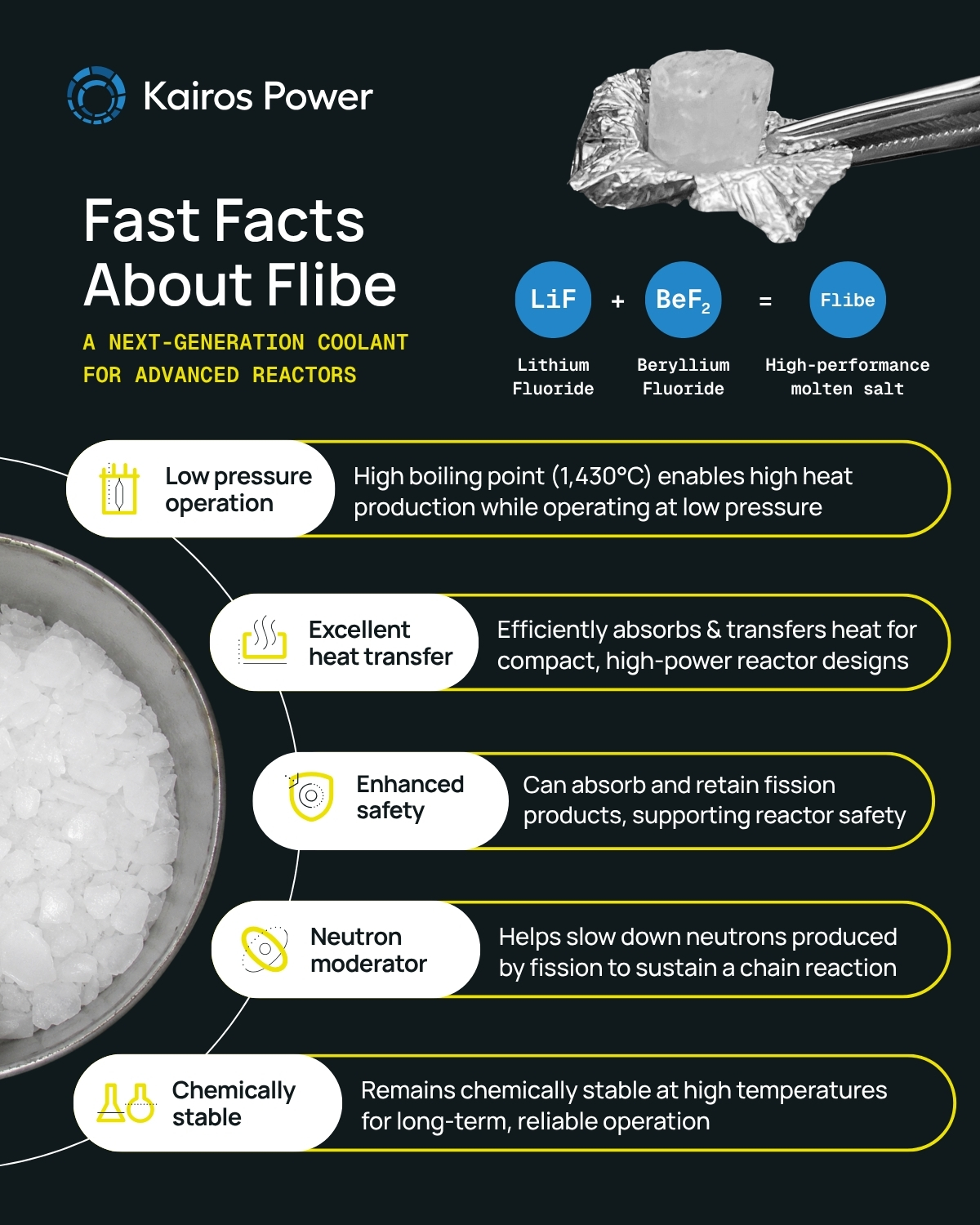
What is Flibe? Five Fast Facts About Kairos Power's Molten Salt Coolant
.jpg)

Kairos Power’s fluoride salt-cooled high-temperature reactor (KP-FHR) will be one of the first reactors to use a fluoride salt coolant, known as “Flibe”. Flibe is a mixture of lithium fluoride (LiF) and beryllium fluoride (BeF2) that was first used as a coolant in the 1960s during the Molten Salt Reactor Experiment at Oak Ridge National Laboratory.
Kairos Power is building on that legacy more than 60 years later to optimize Flibe’s unique properties for reactor safety and performance.
Here are five fast facts to know about Flibe.
1. Flibe carries a lot of heat
Flibe salt has high heat capacity, which means it can absorb and transfer large amounts of heat from the core more efficiently than sodium- or helium-cooled reactor systems. This enables the KP-FHR to generate higher power outputs in a more compact and economical design.
2. Flibe operates at low pressure
Flibe’s high boiling point (1,430°C) is well above the operating range of our commercial reactor. This allows us to operate at high temperature and near atmospheric pressure to increase system efficiency and eliminate the need for costly thick-walled, high-pressure reactor components.
3. Flibe helps retain fission products
Another valuable characteristic of Flibe is its ability to retain fission products.
Flibe provides an additional layer of safety in the KP-FHR, complementing the TRISO fuel to achieve robust functional containment.
In the unlikely event fission products escape from the ceramic coated particle fuel, they are quickly absorbed in the molten salt—eliminating the need for expensive containment structures and shrinking the footprint of safety-related systems to help lower costs.
4. Flibe is more than a coolant
The main job of Flibe is to transfer heat away from the reactor core, but it also acts as a moderator, slowing down the neutrons produced by fission to sustain the chain reaction.
Lithium and beryllium are relatively light elements on the periodic table with low atomic masses. The KP-FHR operates with salt enriched with the lithium-7 isotope. When a fast neutron strikes beryllium and lithium-7, they absorb most of the energy from the collision to significantly slow down the neutron—like a cue ball hitting a billiard ball.
While graphite is the primary moderator in the KP-FHR, Flibe’s contribution helps shrink the reactor’s size, enhance its performance, and ensure it maintains a steady, sustained chain reaction over time.
5. Flibe is chemically stable
Flibe is designed to remain chemically stable under the normal KP-FHR operating conditions of a high-temperature environment protected from oxygen and moisture.
KP-FHR plants will be equipped with chemistry control and inert gas systems that limit exposure to air and continuously remove trace impurities to support long-term operation.
Bringing Flibe production in-house
.jpg)
.jpg)
Kairos Power is vertically integrating the production of Flibe to drive down costs and mitigate supply chain risks for our commercial fleet.
We’re currently building a new Salt Production Facility (SPF) at our Manufacturing Development Campus in Albuquerque, New Mexico, to produce Flibe for the Hermes 2 commercial-scale demonstration plant in Oak Ridge, Tennessee and our future commercial fleet. In addition to making the Flibe, SPF will enrich the salt with the lithium-7 isotope using a novel process developed by Kairos Power for better reactor performance.
The new facility builds off the lessons learned from our Molten Salt Purification Plant in Elmore, Ohio, which produces high-purity salt coolant for our non-nuclear Engineering Test Unit series, where we are gaining experience in the production, handling, and operation of Flibe.
Fast Facts about Flibe Infographic